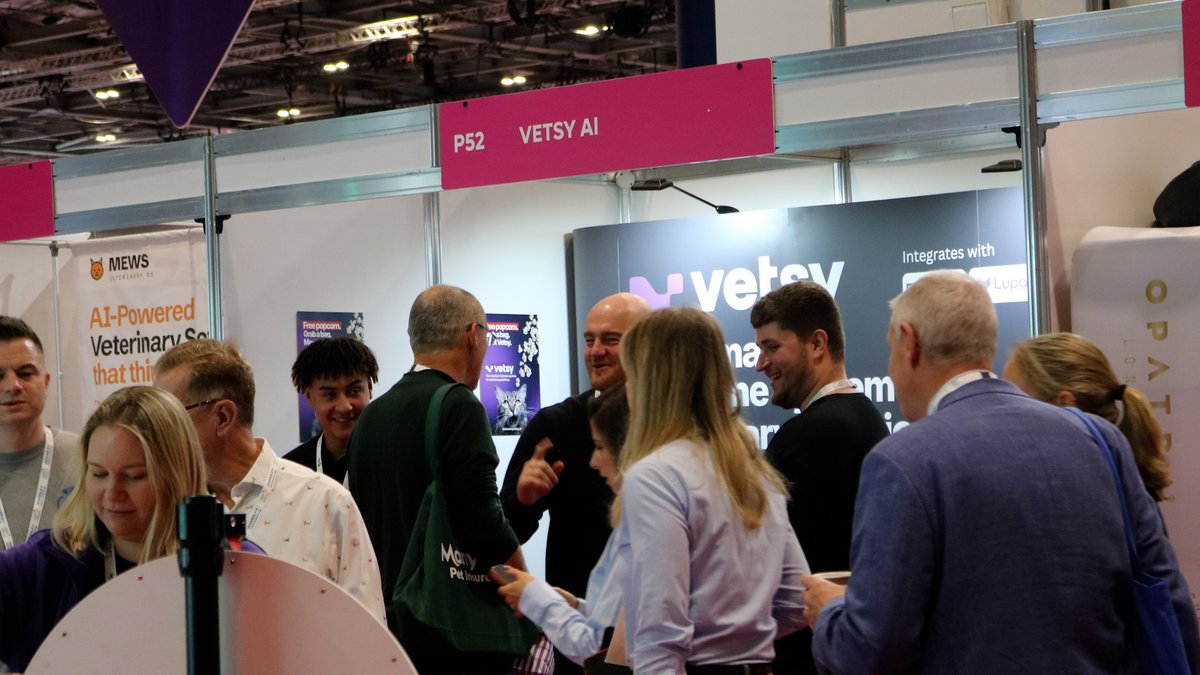
More than 7,000 veterinary professionals descended on the London Vet Show in November. We met as many of them as possible, armed with a microphone and a list of urgent questions, like:
- What’s the biggest misconception about the veterinary sector?
- What’s your favourite vet or pet film?
- What does 2027 hold for us all, and more…?
Their patience and willingness to share the secrets of the sector came as no surprise. Curiosity may kill the cat, but nobody takes care of a genuine question like a vet.
Here’s what we learned…
1. Burnout is real
We’ve previously covered burnout in the veterinary sector. What surprised us was just how many different directions the pressures leading to burnout come from.
“From everywhere really,” says Matthew Steele from Towered Vets in Leeds. “Pressure comes from corporate. Pressure comes from the clients. Pressure comes from just being busy because everyone’s getting more and more pets every year.”

Not surprisingly, resources are stretched. According to Rebecca Setchell from Provet:
“There’s a lack of vets and nurses. So we’ve got to try and be smart with the resources in the clinic.”
It’s one of the areas where technology – and AI in particular – can help reduce burnout.
“The PMS plays a massive part in making work life balance better,” Rebecca continues. “So that’s our mission. To give back more time so they can focus on the care for patients.”

Cost, of course, is a relentless factor in accelerating burnout.
“Everything is more expensive,” says Christo Labuschagne from Clifton Lodge Vets. “You want to be able to pay your team appropriately. And to meet that demand of salaries you need to increase your prices.”
That cause and effect relationship isn’t always obvious to pet parents.
“I think clients still expect 2006 veterinary prices for 2026 veterinary care, and that’s difficult,” Christo concludes.
An often-overlooked source of burnout is that being a vet simply isn’t that easy. Danny de Vries from Clifton Lodge Vets sums up the challenge:
“It’s demanding. I think people expect a lot of you. You’ve got to be everything: dentist, radiologist, surgeon, GP, and medicine specialist.”

Clients are conditioned to see the medical professional and forget the person. As Danny explains:
“We deeply care and we just want to make that change. It’s such a difficult, high pressure job, and we can’t sometimes help taking work home, and ruminating over a case… So you need to look after yourself and sometimes separate that. I’ve done my best. It didn’t always work out. There’s so many other factors that play a role in the success of some outcomes which we don’t have control over, but we feel that we are responsible for that outcome.”
2. They love dogs a lot. Cats come a close second.
You might have thought that, in 2026, it was impossible to find a debate in which all parties could unite behind a single position. But we managed it. It’s as simple as asking vets whether they prefer dogs or cats.
“Definitely dogs because they’re more affectionate.”
Aoi Matsumura, Veterinary Student

“Dogs. They only have one sharp end. Cats have five.”
Danny de Vries
“Dogs. More interactive.”
Lauren Shrouder, Rufford Vets
Don’t panic, pet parents. Loyalties aside, when it comes to taking the best possible care of your pet, all animals are equal.
3. Everyone assumes they’re rich
We need to stop confusing vets and dentists. If vets had a penny for every time a customer assumed it was a lucrative career, they’d be as wealthy as everyone thinks they are.
Coral Rowland of vet.co.uk puts the misconception to bed:
“We are definitely not loaded. And none of it goes to us!” she clarifies, before making an important point about budgets and costs in general.
“We would never offer something that we don’t deem necessary, and people sometimes don’t realize that they can just talk to us about their budget,” she explains. “We’re very open. We understand there’s different financial aspects for every person and every pet.”

Lauren Shrouder has been on the receiving end of the misconception as both receptionist and Head Nurse.
“We’re not business people. So to see someone crying and then ask for money at the end for a receptionist, you feel so guilty. It’s horrible,” she confesses.

4. Rising pet numbers aren’t always great for business
The UK pet population is at its record highest level, and growing. 62% of homes now feature a furball, a figure which jumped by almost 20% during the pandemic. Not surprisingly, that has exacerbated the pressure on practices who are already stretched to the limit in terms of resources and availability.
“There are so many more pets,” confirms Coral Rowland. “So it’s trying to create spaces and time frames that don’t exist during the day to make sure that you have enough time for everyone. That influx of pets in the UK has put a strain, because there’s not necessarily more clinics opening at the same pace.”
5. It’s far more traumatic than people know
As a veteran vet, Danny de Vries has lost count of how many times he’s been told that the role is “just playing with puppies and kittens all day.”
But life around the treatment table can be a far cry from the image presented in practice marketing materials.
For a start, there’s the responsibility of caring for humans, too.
“As a vet, our role is not just tailored towards the animals. We are also acting as a therapist to our clients as well,” explains Dr. Bernard Chia, recognised at the show as a Vet Show 30 under 30 winner. Therapist is a role he embraces.
“We’re not just dealing with animals, we’re also dealing with clients’ emotions and feelings. And I think it’s nice to be like the mediator for both sides in a sense,” he says.

Nevertheless, the emotional toll accumulates, and is not restricted to the clinical side.
The trauma can be for financial reasons, as Harriet Hughes, from Rufford Vets, elaborates:
“It affects the whole team. We’re all there because we love animals and because we want to save them. And it puts us in a very, very emotional turmoil, basically, when we’re unable to do that because people can’t afford it,” she says

For her colleague Lauren, there’s the stark truth that not every animal can be saved.
“It’s constant euthanasia every day,” she says, with the emotional burden on all sides. “Then you go straight to another clinic where you have to be all happy and greet a puppy. It’s just quite an emotional rollercoaster.”
6. But they’re still optimistic about 2027
Make no mistake. You can’t keep a good vet down. Pet numbers might be soaring, customers more demanding, and revenue by no means as abundant as people think, but the outlook is always sunny.
A great deal of credit for that has to go to AI and the potential of tools like Vetsy AI Phone System for easing the pressure on busy practices.
As Greg Thompson of MWI Animal Health UK notes, the market is already saturated, “but the cream will rise to the top.”
In 2027, more practices will discover tools that support their growth.
“Coaching for front of house teams and staff is perhaps something that has been overlooked previously,” says Greg. Previously this would have required a “more manual process of someone sitting by a receptionist or a front of house team member listening and then writing feedback.”

Now, a phone system like Vetsy can do it all through automation and post the results directly to a PMS like Merlin.
According to Greg, it’s a “nice technological solution that will hopefully elevate the quality of service that a practice is providing to their clients over the phone.”
For Rebecca Setchell of Provet, she’s looking forward to a 2027 that’s easier on the front desk.
It’s a dreamscape of “automatic note taking, recording of phone calls, and inputting that directly into a PMS like Provet. That’s the time saver.”
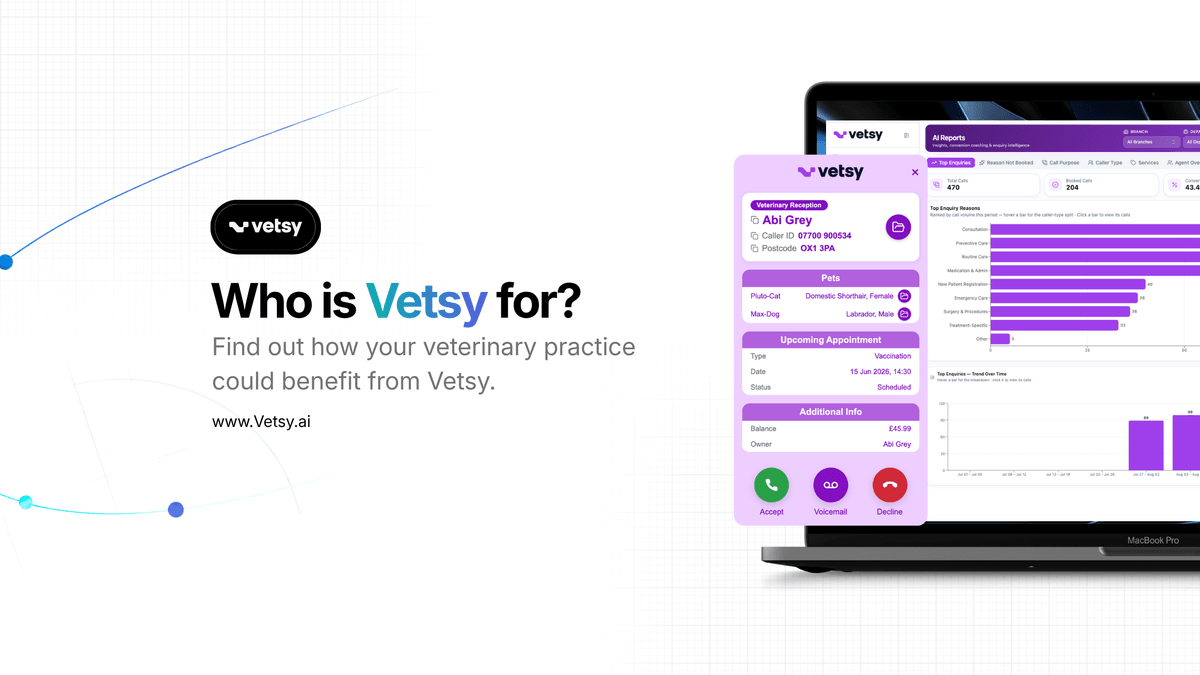
The Smart-caller Pop-up is another feature from the future to be optimistic about.
“When the phone rings, as simple as it sounds, just being able to easily identify the client and patients right away makes it much more personal for the end user,” she enthuses.
Of course, there’s no innovation without integration. Overworked veterinary practices will be best served in 2027 by technology that talks the same language. That starts with building partnerships.
“It must integrate with the practice management system,” confirms Greg Thompson. “The workflow has to be smooth and not work creating. It has to be time saving, not time taking.”
It’s a north star for Lupa, too.
“Vets have a lot of sporadic systems,” says Matei Bjola. “So they’ll have their phone systems, they’ll have their separate WhatsApp integration. We’re trying to bring all of that into one system.”

Looking forward to better calls in 2027?
We spoke to vets in London, and we’re ready to listen to your practice, wherever you are. Find out more about smarter calls and better efficiency across your front desk with Vetsy.